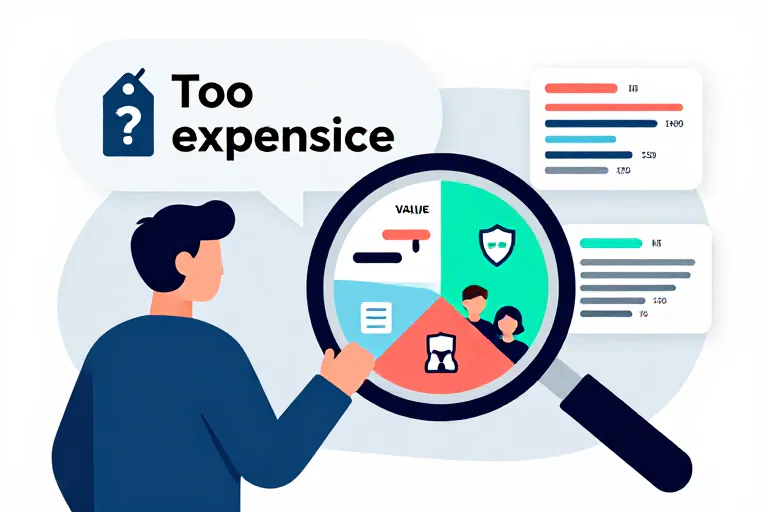
When customers say:
“Too expensive.”
the most obvious interpretation is:
The price is too high.
That interpretation is often too simple.
A customer can think a product is “too expensive” even when they are not asking for a lower price.
They may actually be saying:
- I don't see enough value.
- I don't understand why this costs more.
- I don't trust the product enough.
- I can get something similar elsewhere.
- I don't need it badly enough right now.
- It wasn't what I expected.
- The way the offer is structured doesn't make sense to me.
The words are about price.
The underlying problem may be about value, trust, differentiation, urgency, expectations, or alternatives.
This is why:
“Too expensive” should be treated as a customer signal, not a pricing diagnosis.
Start With a Simple Question: Expensive Compared With What?
Price only has meaning in context.
A $100 product might be:
- cheap compared with a $300 alternative,
- expensive compared with a $30 alternative,
- reasonable if it lasts five years,
- expensive if it breaks after six months,
- worth it for one customer,
- completely unnecessary for another.
So when a customer says:
“It's too expensive.”
the first question should not be:
“How much cheaper should we make it?”
It should be:
“Expensive compared with what?”
That comparison might involve:
- Another product
- Another brand
- Another solution
- The customer's expectations
- The perceived usefulness
- The frequency of use
- The customer's current budget
- The urgency of the problem
Without that context, the statement is incomplete.
1. Low Perceived Value
The most obvious explanation is that the customer does not perceive enough value.
This does not necessarily mean the product has low objective value.
It means:
The customer does not perceive enough value relative to the price.
For example, imagine two customers buying the same product.
Customer A uses it every day and considers it highly useful.
Customer B uses it occasionally and sees little difference between having it and not having it.
The product price is identical.
The perceived value is not.
This creates an important distinction:
Price
+
Perceived Value
=
Customer's Value Judgment
Therefore, lowering the price is not always the right solution.
You may instead need to understand:
What value is missing from the customer's perception?
2. Weak Differentiation
Sometimes customers say something is expensive because they don't see why it should cost more than alternatives.
Suppose:
- Product A costs $50
- Product B costs $90
If the customer cannot identify a meaningful difference, $90 may feel expensive.
The issue may therefore be:
Not high price, but insufficient perceived differentiation.
The customer is effectively asking:
“Why should I pay more for this?”
This is a very different problem from:
“I cannot afford this.”
The first is a differentiation problem.
The second is a budget constraint.
Those require completely different responses.
3. Low Trust
Price can also interact with trust.
Imagine an unfamiliar brand selling a $150 product.
The customer may think:
“That's too expensive.”
But a customer who already trusts the brand might happily pay $150.
The product price did not change.
The customer's confidence changed.
The customer may be uncertain about:
- Product quality
- Durability
- Brand reputation
- Customer support
- Return policy
- Whether the product will actually deliver the promised result
In this situation, the customer may describe the problem as:
“Too expensive.”
But the underlying friction may be:
“I don't trust this enough to risk $150.”
Again, reducing the price is not necessarily the best answer.
4. Low Urgency
Sometimes customers agree that a product is valuable.
They simply don't need it badly enough right now.
Consider:
“I'd like to have it, but it's too expensive.”
This could mean:
“The problem isn't important enough for me to spend this money today.”
That is an urgency problem.
The customer may buy later if:
- The problem becomes more important.
- Their situation changes.
- They experience the problem more frequently.
- A specific event creates urgency.
This is why a customer can simultaneously believe:
“This product is good.”
and:
“It's too expensive.”
There is no contradiction.
The customer may simply not perceive sufficient urgency to justify the purchase now.
5. A Better Alternative Exists
Sometimes customers say:
“Too expensive.”
because another solution gives them enough value at a lower cost.
This is not necessarily a pricing problem in isolation.
It may be a competitive value problem.
For example:
Your product
$100
High quality

Competitor
$70
Slightly lower quality
If most customers cannot perceive the additional value of your product, your $100 price becomes difficult to justify.
The question is therefore not simply:
“Should we charge $80?”
It is:
“Why would a customer choose our $100 product instead of the $70 alternative?”
That question leads directly into competitor intelligence.
6. Expectation Mismatch
Another important possibility is that customers expected something different.
Imagine a customer buys a premium product expecting:
- Better materials
- More features
- Longer durability
- Better performance
- More sophisticated design
After receiving it, they say:
“Not worth the price.”
The problem may not be that the product is objectively overpriced.
The customer may have expected a different experience.
This creates:
Expected Value
        ↓
Actual Experience
        ↓
Expectation Gap
        ↓
"Too Expensive"
This is closely related to the negative-review framework from the previous article.
The customer is evaluating the price after comparing it with the experience they received.
7. Offer Structure Can Make a Product Feel Expensive
Sometimes the underlying product value is reasonable, but the way the offer is structured creates price resistance.
For example:
- One large upfront payment
- Required accessories
- Minimum purchase quantity
- Expensive shipping
- Subscription commitment
- No smaller entry option
The customer may describe the whole experience as:
“Too expensive.”
But the issue could be the structure of the offer rather than the underlying product price.
This is another reason why simply looking at the word “expensive” is insufficient.
The Same Words Can Represent Different Customers
This is where customer context becomes critical.
Imagine 1,000 customers say:
“Too expensive.”
You should not automatically treat them as one group.
Segment them by scenario and customer context.
You might discover:
| Customer group | “Too expensive” may indicate |
|---|---|
| First-time buyers | Low trust |
| Price-sensitive customers | Budget constraint |
| Heavy users | Value may actually be strong |
| Occasional users | Low perceived value |
| Competitor users | Weak differentiation |
| Customers expecting premium quality | Expectation mismatch |
| Customers with low urgency | Problem isn't important enough |
The same sentence can therefore contain multiple underlying problems.
This is exactly why customer analysis should move beyond simple frequency counts.
Why Frequency Alone Isn't Enough
Suppose:
30% of customers say the product is too expensive.
That is important.
But it doesn't tell you what to do.
You need to know:
Why do they think it is expensive?
And even after understanding that, you still need to determine:
How commercially important is the problem?
For example:
- 30% may complain about price but still buy repeatedly.
- 10% may complain about price and abandon every purchase.
- 5% may be high-value customers with strong willingness to pay if the right version exists.
The percentage alone cannot determine the business decision.
This is another example of why:
Statistics describe the market. They don't automatically explain it.
How to Analyze “Too Expensive” With AI
This is where AI can become particularly useful.
Instead of asking:
“Why do customers think this product is expensive?”
give AI a structured investigation.
Step 1 — Find the relevant reviews
Identify reviews containing:
- Expensive
- Too expensive
- Not worth it
- Overpriced
- Worth the money
- Pricey
- Better value elsewhere
Step 2 — Analyze the context
For each customer, identify:
- Customer situation
- Usage scenario
- Product use
- Expectations
- Alternatives mentioned
- Positive experiences
- Negative experiences
Step 3 — Classify the likely underlying reason
For example:
Low perceived value
Weak differentiation
Low trust
Low urgency
Better alternative
Expectation mismatch
Offer structure
The key is that these categories should be defined before the analysis.
AI should classify evidence according to an analytical model rather than inventing arbitrary categories every time.
Step 4 — Look for supporting evidence
Don't simply accept:
“This customer thinks the product is expensive because of low value.”
Ask:
What evidence supports that interpretation?
For example:
Customer says the product works well but doesn't use it often.
That provides stronger evidence for low perceived value than simply seeing the word “expensive.”
Step 5 — Compare customer groups
Now ask:
Which customers perceive the product as expensive?
You might discover that:
- Families perceive it as good value.
- Individual users perceive it as expensive.
- Heavy users perceive it as worth the price.
- Occasional users perceive it as overpriced.
Now you have something much more useful than:
“30% think the product is expensive.”
You understand which customers perceive low value and why.
Don't Ask AI to Decide Whether You Should Lower the Price
This is an important boundary.
AI can help identify:
Why customers perceive the price as high.
But that does not automatically mean AI should conclude:
“Lower the price by 20%.”
The actual business decision requires additional information.
You may need to consider:
- Costs
- Margins
- Sales volume
- Customer lifetime value
- Market size
- Competitors
- Willingness to pay
- Product positioning
- Strategic goals
Customer intelligence is one input into the decision.
It is not the decision itself.
A Better Way to Think About “Too Expensive”
Instead of:
"Too expensive"
      ↓
Lower price
use:
"Too expensive"
      ↓
Understand customer context
      ↓
Identify the underlying friction
      ↓
Validate the interpretation
      ↓
Evaluate commercial significance
      ↓
Choose the appropriate response
The response could be:
- Lower price
- Increase perceived value
- Improve differentiation
- Improve trust
- Improve product experience
- Change positioning
- Change offer structure
- Target a different customer
- Do nothing
The important thing is:
The customer's words should start the investigation, not end it.
What “Too Expensive” Can Really Mean
A useful framework is:
| Customer says | Possible underlying issue |
|---|---|
| “Too expensive” | Low perceived value |
| “Not worth it” | Value/price mismatch |
| “I can get this cheaper elsewhere” | Weak differentiation |
| “I'm not sure about this brand” | Low trust |
| “Maybe later” | Low urgency |
| “Competitor has something similar” | Better alternative |
| “I expected more” | Expectation mismatch |
| “I don't want to pay that much upfront” | Offer structure |
These are hypotheses, not automatic diagnoses.
The next step is always:
Investigate the customer context and evidence behind the statement.
The Bigger Lesson
“Too expensive” is a perfect example of why customer analysis should not stop at what customers explicitly say.
Customers communicate at different levels.
At the surface:
“Too expensive.”
Underneath:
“I don't see enough value.”
Or:
“I don't trust this enough.”
Or:
“I can get what I need elsewhere.”
Or:
“This problem isn't important enough right now.”
Or:
“The product didn't deliver what I expected.”
The job of customer analysis is not to put sophisticated words into the customer's mouth.
It is to investigate which explanation is actually supported by the evidence.
And that distinction matters.
Because the wrong interpretation can lead to the wrong business decision.
A company that sees every:
“Too expensive”
as a pricing problem may start cutting prices when it should have been improving differentiation, positioning, trust, or perceived value.
Final Framework
When customers say:
“Too expensive.”
don't ask:
“How much should we lower the price?”
Ask:
Who says it?
      ↓
In what scenario?
      ↓
Compared with what?
      ↓
What did they expect?
      ↓
What value did they perceive?
      ↓
What alternatives do they have?
      ↓
What evidence supports the explanation?
      ↓
How commercially important is it?
      ↓
What action, if any, makes sense?
This turns a simple pricing complaint into a customer investigation.
And that is the real value of AI-assisted customer analysis:
Not finding more mentions of “too expensive,” but understanding what customers actually mean when they say it.
Related
What Is Customer Intelligence? Understand the broader framework for turning customer signals into deeper business insight.
How to Analyze Customer Reviews With AI Learn how to move from raw reviews to customer scenarios, needs, motivations, and opportunities.
What Do Negative Reviews Really Tell You About Your Customers? Learn why a negative review is a signal to investigate rather than an automatic diagnosis of a product problem.
AI Customer & Review Insight Analyzer Analyze customer reviews, feedback, and comments with a structured AI workflow.