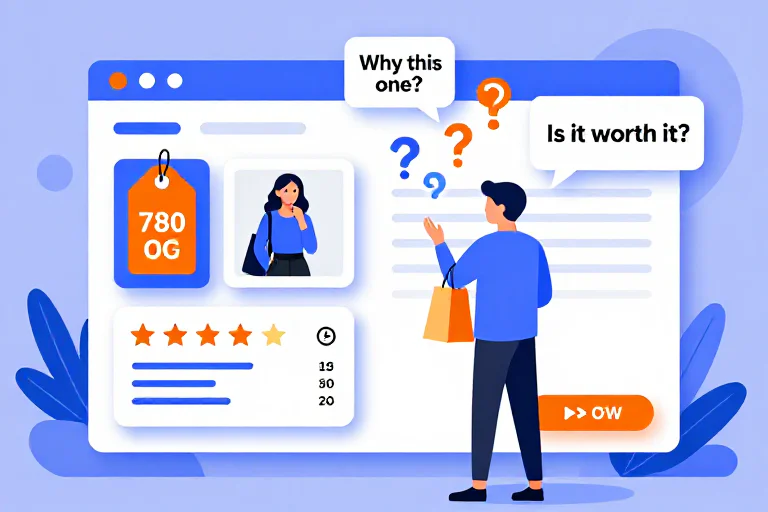
A product page can contain almost everything a shopper could possibly need.
Photos.
Specifications.
Reviews.
Materials.
Shipping information.
Returns.
Guarantees.
FAQs.
A big Add to Cart button.
And yet a shopper can still look at the page and think:
“I'm not sure.”
That's the interesting part.
The question isn't really whether the product page contains the right components.
The question is:
Does the page help this particular shopper make the decision they're trying to make?
That's what I would want an AI Shopper to look for.
Not whether the page follows some ideal ecommerce template.
Not whether every element is in the “correct” position.
But whether the page gives a shopper enough context, evidence, and confidence to move forward.
Start With What the Shopper Is Trying to Figure Out
A shopper doesn't arrive at a product page with a checklist.
They arrive with a situation.
Maybe they need a desk because they work from a small bedroom.
Maybe they want a mattress because they keep waking up uncomfortable.
Maybe they need a jacket because they're traveling somewhere cold.
The product page is being evaluated against that situation.
So the first thing an AI shopper should ask is:
Does this product make sense for the job I'm trying to solve?
That sounds obvious, but a lot of product pages answer a different question.
They explain the product.
They don't explain the relevance.
For example:
Made from premium solid oak.
That tells me something about the product.
But if I'm shopping for a desk in a tiny apartment, I may care more about:
Fits comfortably into a 40-inch-wide workspace without sacrificing usable surface area.
One is a product fact.
The other helps me make a decision.
A useful AI shopper should be able to tell the difference.
1. Does the Page Make the Product Easy to Understand?
Before a shopper can evaluate a product, they need to understand it.
That doesn't mean knowing every specification.
It means answering a few basic questions quickly:
What is this?
Who is it for?
What problem does it solve?
What makes it different?
This is where overly abstract ecommerce copy creates problems.
A brand might say:
Thoughtfully designed essentials for a more intentional lifestyle.
It sounds polished.
It tells the shopper almost nothing.
The shopper shouldn't need to decode your positioning before deciding whether the product is relevant.
An AI shopper should pay attention to this first layer because everything else depends on it.
If the shopper doesn't understand the product, reviews don't fix the problem.
A guarantee doesn't fix it.
A stronger CTA doesn't fix it.
There is nothing to optimize until the product itself makes sense.
2. Does the Product Match the Shopper's Situation?
Understanding a product isn't enough.
The shopper needs to see themselves using it.
This is where product page analysis becomes much more interesting than checking whether the page has a feature list.
Consider a lamp.
The merchant might emphasize:
- 2700K warm light
- dimmable LED
- aluminum body
- touch controls
All useful.
But imagine the shopper is trying to create a quiet reading corner in a bedroom.
Now different information becomes important:
Does it produce enough light to read comfortably?
Is the light too harsh at night?
Does it take up much space on a bedside table?
Will it look good next to warm wood and linen?
The same product can be evaluated very differently depending on the shopper's goal.
This is one reason I don't think an AI shopper should be completely generic.
A useful simulation needs some idea of what the shopper is actually trying to accomplish.
Otherwise, it can only judge the page in the abstract.
3. Does the Page Explain Why This Product Is Worth the Price?
This is one of the most important things to inspect.
Not because expensive products are bad.
Because price creates a question.
If I see a $29 product, I might not spend much time evaluating it.
If I see a $299 product, I probably will.
And if I see a $1,500 product, the page has a very different job.
The product page needs to help me understand:
Why is this worth $1,500?
That doesn't necessarily mean writing more copy.
It might mean showing:
- better materials
- better construction
- stronger proof
- a specific problem the product solves
- durability
- craftsmanship
- service
- warranty
- scarcity
- meaningful differentiation
The important thing is that the shopper can connect those facts to the price.
Otherwise the page may quietly create a comparison problem:
“This looks nice, but I can probably find something similar for less.”
At that point, the merchant may think they have a pricing problem.
The real problem might be value communication.
4. Does the Page Give Me Reasons to Believe the Claims?
This is where I would separate information from evidence.
A page can tell me:
Premium materials.
That's a claim.
It can show me close-up photos of the material, explain what it is, show how it compares, and provide customer feedback describing how it holds up.
Now I have evidence.
That's a much stronger experience.
The same thing applies to almost every important product claim.
If the page says:
Extremely comfortable.
I want to know:
According to whom?
Why?
What makes it comfortable?
Is there evidence from customers?
Is there something about the design that explains it?
An AI shopper should therefore look for the gap between:
What the brand says
and
What the shopper has enough evidence to believe.
That gap is often where trust starts to break down.
5. Can I Find the Answers to the Questions I Naturally Have?
This is one of the easiest things for a merchant to underestimate.
Because the information may already exist.
The problem is that the shopper has to go looking for it.
Imagine I am interested in a $700 chair.
I immediately want to know:
How big is it?
What's the actual seat height?
What does it feel like?
How long will delivery take?
Can I return it?
What if it arrives damaged?
How does the fabric hold up?
The brand might answer every one of those questions somewhere across:
- the product page
- FAQ
- shipping policy
- returns page
- help center
- footer
Technically, everything is there.
From the shopper's perspective, there are still unanswered questions.
This is an important distinction:
Available information is not the same thing as accessible decision-making information.
A useful AI shopper should notice when a question becomes important and then see how difficult it is to answer.
6. What Happens When the Shopper Has to Leave the Product Page?
This is another place where context matters.
Sometimes opening another page is completely normal.
Nobody expects a serious shopper to buy a $1,000 product after reading one paragraph.
But there is a difference between:
“I want more information.”
and:
“I have to hunt through the website to find basic information before I can decide.”
Suppose the product page gives me a price but no delivery estimate.
I click Shipping.
Then I have to navigate another page.
Then I realize the delivery estimate depends on location.
Then I have to find another piece of information.
At each step, the shopper is doing work.
One small amount of effort may not matter.
Several in a row can.
That's what friction looks like in practice.
Not necessarily a broken checkout.
Sometimes it's just too much mental work for a decision that should have been easier.
7. What Risk Does the Shopper Still Feel?
People don't only evaluate what they might gain from a purchase.
They think about what could go wrong.
That's particularly important for unfamiliar brands.
The shopper may be thinking:
What if I don't like it?
What if the quality isn't what I expected?
What if the color is different in person?
What if it doesn't fit?
What if shipping takes too long?
What if returning it becomes a nightmare?
This is why policies are part of the product experience.
A return policy isn't merely legal information.
It changes the perceived downside of trying the product.
And the same is true of:
- guarantees
- warranties
- customer support
- delivery estimates
- review quality
- real product photography
An AI shopper should therefore ask not only:
“Is there a return policy?”
but:
“Has this page reduced enough of my perceived risk for me to feel comfortable continuing?”
That's a much more useful question.
8. Is There Enough Information to Compare This Product With Alternatives?
This is where things get uncomfortable for some brands.
The shopper does not live inside your website.
They have tabs open.
They can search Google.
They can check Amazon.
They can visit a competitor.
They can compare prices in seconds.
So the product page needs to answer something beyond:
“Why is this a good product?”
It needs to help answer:
“Why should I choose this one?”
That might come from:
- better design
- better materials
- better quality
- better fit for a particular use case
- stronger support
- better guarantees
- better delivery
- a specific feature competitors don't offer
- a brand position that actually matters to the shopper
But “we care more” isn't differentiation.
“Designed with intention” isn't differentiation.
“Premium quality” isn't differentiation.
If the product page makes a premium claim but the shopper can't see what makes the product meaningfully different, comparison becomes almost inevitable.
This is where an AI shopper can surface something a merchant may not notice:
The product page explains why the product is good, but not why it is preferable.
Those are very different things.
9. Does the Page Help Me Decide, or Just Keep Giving Me More Information?
More information isn't always better.
A product page can become a warehouse of facts.
Thirty specifications.
Eight feature blocks.
Four benefit sections.
A giant FAQ.
Long reviews.
More images.
More badges.
More copy.
At some point, the shopper isn't getting more confident.
They're getting tired.
This is one reason I don't like using “completeness” as the main standard for a product page.
The goal isn't:
Put everything on the page.
The goal is:
Give the shopper the information they need at the moment it helps them decide.
That is a very different design problem.
The AI Shouldn't Treat Every Missing Element as a Problem
This is another important distinction.
Suppose a product page doesn't have a video.
Is that a problem?
Not necessarily.
Suppose it doesn't have a sticky Add to Cart button.
Not automatically a problem.
Suppose it doesn't have a “30 reasons to buy” section.
Probably fine.
The question isn't:
Does this page contain every feature recommended by a CRO checklist?
The question is:
Did the absence of this information make the specific shopper's decision harder?
That is a much better standard.
A first-time buyer might care deeply about brand credibility.
A comparison shopper might barely care.
A price-sensitive shopper might care enormously about value justification.
Context changes the answer.
This Is Why One Product Page Can Have Three Different Problems
Imagine a product page for a $220 desk lamp.
A first-time buyer might say:
“I don't really understand what makes this brand different.”
The price-sensitive buyer might say:
“I like it, but I don't understand why it costs $220.”
The comparison shopper might say:
“I can find similar-looking lamps elsewhere. Why this one?”
Same page.
Three different purchase blockers.
And none of those findings should automatically become:
“The page needs better UX.”
The actual problem is more specific.
That's what I would want from an AI Shopper.
A Product Page Should Be Judged Against a Decision, Not a Template
This is probably the simplest way I would summarize the whole idea.
A traditional product page audit might ask:
- Is there a CTA?
- Are there reviews?
- Is the price visible?
- Is there a return policy?
- Are there trust badges?
- Is the page mobile-friendly?
Those checks are useful.
But they are only the beginning.
A shopper-centered evaluation asks:
Can I understand this product?
Can I see why it matters to me?
Can I understand the value?
Do I have enough evidence to believe the claims?
Can I answer the questions that matter to me?
Do I understand the risks?
Can I see why I should choose this instead of another option?
Do I feel confident enough to continue?
That's much closer to the actual buying decision.
This Is Where AI Shopper Becomes More Than a Product Page Auditor
The interesting part is that the AI doesn't have to treat every page the same way.
It can enter with a goal.
A persona.
A budget.
A reason for shopping.
A different level of familiarity with the brand.
Then the page gets evaluated in context.
The same product page can produce different findings depending on who is looking at it.
And when those findings are tied back to concrete evidence—what the shopper saw, what information was missing, where it looked, and what happened next—you get something much more useful than a generic score.
You get a picture of how a potential buyer might experience the page.
The Question I Would Use to Evaluate Any Product Page
Before asking whether your product page is “optimized,” ask:
If I were actually trying to buy this product, what would I still need to know before I felt comfortable choosing it?
Then look at the page from there.
Maybe the answer is obvious.
Maybe the product needs better proof.
Maybe the offer isn't strong enough.
Maybe the price isn't adequately justified.
Maybe the product is too similar to everything else.
Maybe the information exists, but it appears too late.
And sometimes the page is doing its job perfectly.
The shopper just isn't interested.
That's useful to know too.
Because not every visitor is supposed to buy.
The job of a good product page isn't to force the decision.
It's to make the decision easier for the right shopper.
And that's exactly the kind of question an AI Shopper should be asking.