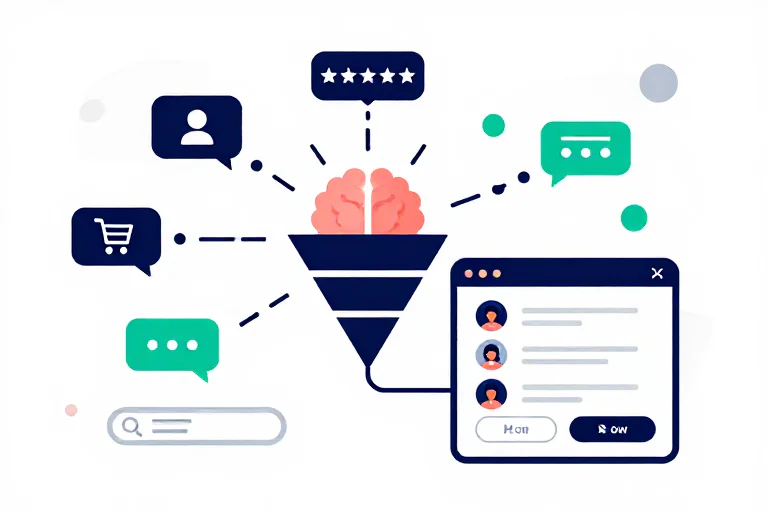
Customer intelligence is more than collecting reviews, tracking satisfaction scores, or counting how often customers mention a problem. For ecommerce teams, the real value comes from understanding who customers are, how they use a product, what they actually need, and what those signals mean for the business.
A store can have thousands of customer reviews and still have a surprisingly shallow understanding of its customers.
You might know that 30% of customers mentioned size, 20% mentioned price, and many customers described a product as “beautiful.”
But what does that actually tell you?
Why did those customers care about size?
Who thought the product was too small?
In what situation was it too small?
What were they actually trying to accomplish?
And, most importantly:
What should the business do about it?
This is where customer intelligence becomes more useful than simply collecting customer data.
What Is Customer Intelligence?
Customer intelligence is the practice of turning customer signals into a deeper understanding of customers and using that understanding to support business decisions.
Those signals can come from many places:
- Customer reviews
- Customer feedback
- Support conversations
- Product questions
- Returns
- Purchases
- Product usage
- Surveys
- Search behavior
- Customer segments
- Competitor interactions
The important part is that customer intelligence does not stop at describing these signals.
A useful way to think about the process is:
Customer signals → Context → Customer groups → Needs → Validation → Business opportunity → Decision
The goal is not simply to know what customers said.
The goal is to understand what their signals mean in context and determine whether that understanding should change something in the business.
Customer Data Is Not the Same as Customer Understanding
This distinction is easy to overlook.
Suppose an ecommerce company has 10,000 customer reviews.
An analysis might report:
32% of customers mentioned size. 21% mentioned price. 15% mentioned color. 11% mentioned durability.
There is nothing wrong with this analysis.
In fact, statistics like these can be useful.
The problem is that they mainly describe what customers mentioned.
They do not necessarily explain:
- Why customers mentioned it
- Which customers mentioned it
- What situation they were in
- What problem they were trying to solve
- Whether the issue actually affected their decision
- Whether the issue represents an opportunity
- What the business should do next
Traditional customer analysis is therefore still valuable, but it often depends heavily on the person interpreting the data.
A strong analyst can take the same data and discover useful patterns.
A less experienced analyst may simply turn the numbers into a list of observations.
The limitation is not that statistics are wrong.
The limitation is that statistics alone are no longer enough.
Context Can Be More Valuable Than the Statement Itself
Consider a customer saying:
“Beautiful.”
At first glance, this looks like a positive product signal.
But by itself, it tells you relatively little.
Now consider:
“Beautiful in my minimalist bedroom.”
That gives you more context.
Or:
“It makes my small bedroom feel calmer.”
Now the meaning becomes even more interesting.
The customer may not simply be saying that the product looks good.
They may be describing how the product fits into their environment and the experience it creates.
This distinction matters because appearance is contextual.
Something that looks beautiful to one customer may not look beautiful to another customer because their environments, preferences, and expectations are different.
The same applies to many other customer statements.
“Too small.”
“Too expensive.”
“Easy to use.”
“I love it.”
These statements are signals.
They are not necessarily complete explanations.
The next question should often be:
In what context?
Customer Statements Are Not Always Customer Needs
One of the easiest mistakes in customer analysis is treating what customers ask for as their underlying need.
Imagine several customers say:
“I wish this product were bigger.”
It is tempting to conclude:
Customers need a larger product.
But that may not be the real problem.
Consider different scenarios.
A family might want a larger version because several people need to use the product together.
A customer living in a small apartment might have a completely different problem. They might actually want a product that takes up less space.
Another customer might want more space simply because they want a more comfortable individual experience.
The statement is the same:
“I want it bigger.”
The underlying situations are different.
That means the analysis should not immediately turn the customer's suggested solution into a product requirement.
Instead, start by understanding the scenario.
Customer statement → Scenario → Underlying need
This is one reason customer segmentation should often go beyond demographic categories.
The more useful question may not simply be:
“Who is this customer?”
It may be:
“Who is this customer, what are they trying to do, and in what situation are they using the product?”
Why Customer Scenarios Matter
An average customer score can be useful.
For example:
Overall satisfaction: 4.5/5
But an average can hide important differences.
Imagine the same product receives:
| Customer context | Satisfaction |
|---|---|
| Single users | 4.8 |
| Couples | 4.7 |
| Families | 3.5 |
| Small-apartment users | 4.9 |
The product does not simply have a “4.5/5 customer experience.”
It performs differently in different customer contexts.
That changes the questions a business should ask.
Instead of:
“Why is satisfaction 4.5?”
You can ask:
“Why does the product work particularly well for single users?”
“What is different about the family use case?”
“Is the problem the product itself, or is the product being positioned toward the wrong customer?”
This can lead to very different decisions.
The answer might be:
- Change the product
- Introduce another size
- Create different product variants
- Change positioning
- Change messaging
- Target a different customer segment
- Or decide that a particular segment is not commercially attractive enough to pursue
The scenario gives the signal meaning.
Frequency Does Not Equal Business Value
Another common assumption is:
The more customers mention something, the more important it must be.
This is useful as a starting point, but it is not enough.
Suppose:
30% of customers mention color.
But only:
3% mention a particular use case.
It would be easy to conclude that color is the bigger opportunity.
But what if those 3% of customers:
- Have much higher order values
- Use the product more consistently
- Have higher margins
- Are more willing to pay
- Have stronger unmet needs
- Are actively looking for alternatives
Then the smaller signal could represent a much more valuable opportunity.
This is why frequency should be treated as evidence, not as a direct measurement of business value.
The commercial importance of a customer need may depend on many factors:
- Customer value
- Usage
- Willingness to pay
- Market size
- Market growth
- Competition
- Product cost
- Margin
- Product feasibility
- Strength of the pain point
There is no universal formula that can automatically turn these variables into the “correct” decision.
The point is to move beyond:
“How many people said this?”
and ask:
“How important is this need, for whom, in what context, and what could it mean for the business?”
Usage Can Tell You More Than Purchase Alone
Buying a product does not necessarily mean that the product successfully solved the customer's problem.
A customer can purchase something frequently and still stop using it after discovering an alternative.
Likewise, another product might be used relatively infrequently but remain the customer's preferred solution whenever the relevant situation occurs.
So the important question is not simply:
“How often is the product used?”
It is:
“After experiencing the product, does the customer still want to use it when the relevant need occurs?”
That distinction matters.
Usage provides another layer of evidence about whether the product actually fits the customer's situation.
It can also help distinguish between:
- A product that is naturally used occasionally
- A product that customers stop using because it failed to meet expectations
- A product that customers replace with a competitor
- A product that remains valuable despite relatively low usage frequency
Customer intelligence therefore benefits from looking beyond what customers say and considering what they actually do.
AI Changes How Deeply We Can Analyze Customers
AI does not make customer intelligence valuable simply because it can process more reviews.
The more important change is that AI can help execute deeper analytical processes across much larger datasets.
Historically, a company might have thousands of reviews but only a small number of people capable of interpreting them deeply.
The process often looked like:
Customer data → Statistics → Expert interpretation → Decision
The expert remains extremely important, but this creates a scaling problem.
A strong analyst can only manually examine so much information.
AI changes the economics of this process.
With a well-designed analytical framework, AI can help:
- Classify customer statements
- Cluster similar situations
- Identify recurring patterns
- Compare customer groups
- Extract customer language
- Analyze large volumes of feedback
- Cross-reference different signals
- Run repeated rounds of analysis
- Surface possible explanations
- Generate hypotheses for further investigation
This creates an important opportunity.
The deep analytical experience of one person can be translated into a process that AI can execute repeatedly at scale.
That is much more interesting than simply asking AI to summarize reviews.
AI Needs Context to Produce Useful Analysis
Giving an AI system more raw data does not automatically produce better analysis.
Consider two instructions.
Approach 1
Analyze these 10,000 customer reviews.
Approach 2
First identify the major customer usage scenarios. Use the predefined scenario model to classify customers. Then analyze the needs and problems within each scenario. Compare the resulting patterns across customer groups and validate important findings against other available signals.
The second task gives AI a way to reason about the data.
This is what I mean by analytical context.
Context is not simply:
More information.
It can include:
- Your analytical model
- Your definitions
- Your classification rules
- Your experience
- Your assumptions
- Your business objectives
- Your decision criteria
- Your understanding of the product
- Your understanding of the market
For example, if you want AI to classify customers according to a particular psychological model, you need to define the model and its classification criteria.
Otherwise, AI may create its own categories that are not useful for your business.
The same principle applies to customer scenarios, needs, motivations, and other analytical dimensions.
AI can execute a framework, but someone still needs to decide what framework should be used.
AI Should Not Be Treated as an Unquestioned Decision Maker
This is another important distinction.
AI can make judgments.
But an AI-generated judgment should not automatically become a business decision.
For example, an AI system might conclude:
“Family customers represent an opportunity for a larger product.”
That can be useful.
But the next step should not automatically be:
“Launch the larger product.”
You still need to evaluate:
- How many customers are in this segment?
- How strong is the need?
- What are they willing to pay?
- Are competitors already solving it?
- What would the product cost?
- What would the margin look like?
- Can the product actually be produced?
- Is the market large enough?
- Can the opportunity expand beyond the initial segment?
The AI's conclusion becomes input into a decision, not the decision itself.
A useful mental model is:
Human defines the analytical context → AI executes the analysis → Human validates the findings → Business makes the decision
Cross-Signal Validation Matters
Customer reviews are valuable, but no single customer data source should automatically be treated as the complete truth.
A customer may not leave a review.
A customer may not explain the real reason for a return.
A customer may say one thing and behave differently.
A review can also contain noise.
That is why important findings should ideally be examined across multiple signals.
For example, suppose reviews repeatedly mention:
“Too small.”
You might then examine:
- Customer support questions
- Return reasons
- Product usage
- Sales patterns
- Search behavior
- Customer segments
- Competitor offerings
If multiple independent signals point toward the same issue, confidence in the finding increases.
If they contradict each other, that contradiction itself becomes something worth investigating.
This is why customer intelligence should not be:
“Find the most common sentence.”
It should be:
“Build the strongest explanation supported by the available evidence.”
From Customer Understanding to Business Opportunity
Understanding customers is valuable.
But understanding alone is not the final objective.
Suppose you discover:
Families want a larger version of a product.
That is a customer insight.
It is not automatically a business opportunity.
You still need to connect the insight with commercial reality.
A useful progression is:
Customer signal
→ What did customers say or do?
Context
→ In what situation did it happen?
Customer group
→ Which customers experience it?
Underlying need
→ What are they actually trying to accomplish?
Validation
→ Does other evidence support the interpretation?
Business relevance
→ Is the need commercially meaningful?
Opportunity
→ Is there something the company could realistically do?
Decision
→ What should happen next?
That final step might involve:
- Product development
- A new product variant
- Product positioning
- Customer targeting
- Messaging
- Product education
- Pricing
- Or deciding not to pursue the opportunity
The point is not to turn every customer complaint into a product change.
The point is to make better decisions because you understand the customer more deeply.
A Practical Customer Intelligence Model for Ecommerce
Putting these ideas together, a practical process looks like this:
Customer Signals
        ↓
Context & Scenarios
        ↓
Customer Groups
        ↓
Underlying Needs
        ↓
Cross-Signal Validation
        ↓
Business Relevance
        ↓
Opportunity
        ↓
Decision
AI can support almost every analytical step in this process.
But the quality of the output depends heavily on the analytical context provided by the person using it.
The better the model, definitions, assumptions, and business context, the more useful the AI analysis can become.
What Customer Intelligence Should Ultimately Give an Ecommerce Team
At the end of the process, you should not simply have another dashboard.
You should have a clearer understanding of questions such as:
Who is actually buying?
Not just demographics, but meaningful customer groups and contexts.
Who is actually using the product?
And whether the product continues to fit their needs after purchase.
Why do customers buy?
What situations, motivations, and expected outcomes drive the purchase?
Why are customers dissatisfied?
And whether the problem is the product, expectations, positioning, usage, or something else.
What does the customer really need?
Beyond the specific solution they happen to ask for.
Where does the product perform well?
And for which customer scenarios?
Where are the opportunities?
Which unmet needs may be commercially meaningful?
What should the business do next?
Because understanding customers without acting on that understanding has limited value.
Customer Intelligence Is Becoming a Decision System
The biggest change brought by AI is not simply that ecommerce companies can analyze more customer data.
It is that deeper customer analysis can become much more scalable.
In the past, companies often depended on experienced analysts to interpret customer data.
Today, AI can execute increasingly sophisticated analytical processes across large datasets.
But this does not mean businesses should simply give their data to AI and ask:
“Tell me what customers want.”
A better approach is to provide AI with a clear analytical context, let it execute the work, challenge its conclusions, validate important findings, and then connect those findings to commercial decisions.
The goal is not:
More customer data.
It is not even:
More customer analysis.
The goal is:
A deeper understanding of customers that can lead to better decisions.
That is where customer intelligence becomes commercially useful.
Final Thought
A customer review is only one signal.
A statistic is only one description.
An AI-generated insight is only one interpretation.
The real value appears when these pieces are connected:
Signal → Context → Understanding → Validation → Opportunity → Action
For ecommerce teams, that is the difference between knowing what customers said and actually understanding what their behavior and feedback mean for the business.
Continue exploring
Customer Intelligence Explore more frameworks for understanding customer feedback, needs, scenarios, and behavior.
How to Analyze Customer Reviews With AI Learn how to move from raw reviews to structured customer insights.
What Do Negative Reviews Really Tell You About Your Customers? Explore why negative feedback can reveal more than simple product dissatisfaction.
AI Review & Customer Insight Analyzer Turn customer reviews, feedback, comments, or text into structured signals for further analysis.