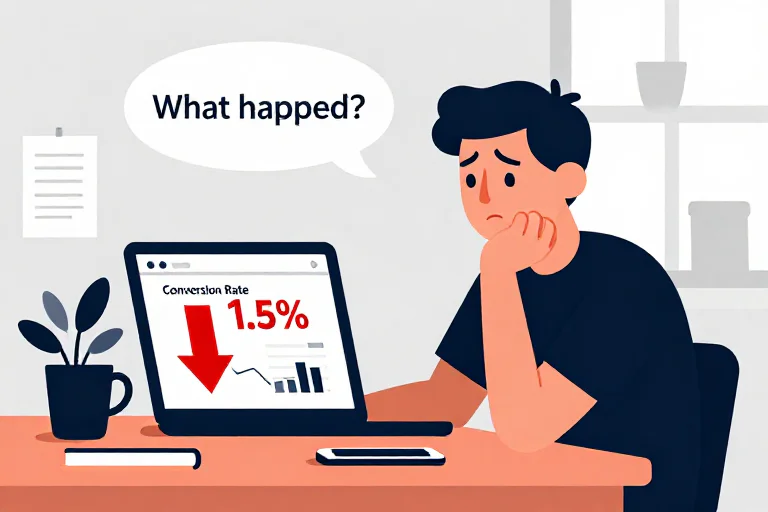
A dashboard can tell you that conversion rate fell.
It can tell you revenue is down.
It can tell you fewer people added a product to their cart.
It can tell you mobile conversion is lower than desktop.
All of that is useful.
But none of those numbers, by themselves, can tell you what actually happened to the business.
That distinction sounds obvious until something goes wrong.
A store owner opens Shopify or GA4, sees a number moving in the wrong direction, and immediately starts looking for something to fix.
The product page.
The offer.
The ads.
The checkout.
The price.
Something must be broken.
Maybe.
But the number did not tell you that.
It only told you that something changed.
And I think that is where ecommerce analytics is often misunderstood.
Analytics is very good at observing the business. Diagnosis is about understanding what may be happening inside it.
Those are not the same job.
A conversion rate drop is an observation, not an explanation
Imagine a store where conversion rate falls from 2.4% to 1.5%.
The first thing many people do is look for the reason.
But before looking for a reason, I would question the description of the problem itself.
What does "conversion rate fell" actually mean?
It means that the relationship between sessions and orders changed.
It does not tell you why.
And even something as simple as "traffic stayed the same" doesn't tell you much on its own.
Total traffic can stay almost exactly the same while the people behind that traffic change significantly.
You could have less organic traffic and more paid traffic.
You could have fewer returning customers and more first-time visitors.
A high-converting channel could become a smaller part of the mix while a low-converting channel becomes a larger one.
Mobile visitors could increase while desktop visitors decrease.
A campaign could start attracting a different type of person even though clicks and sessions look healthy.
In some cases, every segment can behave normally while the overall number gets worse simply because the composition changed.
So when someone says:
"Traffic hasn't changed, but conversion dropped."
my next question is usually:
Which traffic?
That is a much more useful question.
A total number can hide a change in its underlying structure.
This isn't a theoretical problem. Ecommerce sellers regularly run into situations where the top of the funnel looks normal while something further down appears to have broken.
In a May 2026 Shopify discussion, one store owner described a sharp decline in add-to-cart and purchase conversion while CTR, CPC, and CPM remained relatively stable across both Meta and Google traffic. The store still looked normal to a human visitor, which made the problem much harder to explain.
Another Shopify seller recently reported that their displayed conversion rate had apparently fallen from around 1.5% to 0.6%, while their own calculation produced something much closer to 1.4%. The discussion quickly moved away from "how do I optimize conversion?" and toward a more fundamental question:
Is the number itself describing a real business change?
People started investigating the denominator, sessions, referral patterns, possible bot traffic, reporting differences, and checkout behavior.
That is diagnosis.
Not because someone found the answer immediately.
Because they realized that the first number was only the beginning of the investigation.
The business is the thing that changes. Data is how we observe it.
This is an important distinction for me.
I don't think the purpose of ecommerce analytics is to turn every part of a business into a number.
The business exists first.
Customers make decisions. Products are bought or ignored. People change their preferences. New competitors appear. Existing customers behave differently. Marketing changes who arrives at the store. A product becomes less relevant. A product becomes more useful. Expectations change.
Those things happen in the business.
We cannot directly measure "the business" as one clean variable.
So we use data to observe its behavior.
Revenue, orders, sessions, conversion rate, average order value, and other metrics are useful precisely because they leave traces of what is happening.
But a trace is not the thing itself.
That is why I don't like the habit of treating a dashboard as if it were the business.
It isn't.
The dashboard is a view of the business.
And sometimes it is a very incomplete view.
This becomes especially important for smaller ecommerce businesses.
Large companies can have enough data, research teams, analysts, experimentation infrastructure, and historical context to investigate questions from many different directions.
A small store usually doesn't.
It may have a few thousand visitors.
A relatively small number of orders.
Some product reviews.
Some customer emails.
A handful of support conversations.
Comments on social media.
Maybe a few Reddit discussions.
And a dashboard.
That does not mean the business has no evidence.
It means the evidence is fragmented.
Small data changes the problem
There is another reason I am cautious about putting too much weight on a small ecommerce dataset.
When the number of observations is small, the numbers can become extremely sensitive.
A handful of orders can move a conversion rate significantly.
A small change in traffic can make a percentage look much more dramatic than the underlying business change really is.
That doesn't make the data useless.
It means the data needs context.
This is where I think many small ecommerce businesses are stuck.
They have enough data to see that something is happening, but not enough quantitative data for the numbers to explain everything by themselves.
And that's where customer evidence becomes much more interesting.
Suppose a store has only a relatively small number of orders, but it also has hundreds of customer reviews and support conversations.
Those conversations contain information that a conversion-rate chart simply cannot contain.
Customers may explain:
- what confused them,
- what they expected,
- what they compared,
- what they were worried about,
- what almost stopped them,
- what finally convinced them,
- what disappointed them after purchase.
That isn't a replacement for quantitative data.
It is a different kind of evidence.
And sometimes it is more informative about the question you are actually trying to answer.
Customers leave clues that never appear in a dashboard
Consider a customer who says:
"It's expensive."
That sentence is easy to classify.
Negative sentiment.
Price complaint.
Potential pricing issue.
But now imagine the same customer eventually buys the product.
The meaning changes.
Maybe they thought the product was expensive.
Maybe it exceeded what they could comfortably spend.
But they still decided it was worth buying.
And that decision changes what the original statement means.
The customer may now expect more from the product.
They may tolerate the price while becoming less tolerant of poor quality.
They may compare it more carefully against alternatives.
They may have a much higher expectation of value.
A basic sentiment-analysis system can easily miss all of that.
It sees:
expensive → negative.
But the customer did something more complicated than expressing a negative sentiment.
They evaluated a trade-off and made a decision.
That is the kind of thing I find interesting about customer evidence.
The useful information is often not in the obvious label.
It is in the relationship between what the customer says and what the customer does.
And sometimes the most interesting signal is the contradiction.
The customer says one thing but behaves another way.
Customers complain but still buy.
Customers praise a feature but never mention it when explaining why they purchased.
Customers say something is "easy to use" while repeatedly asking support how to use it.
Customers say they want more options but consistently choose the same option.
Those contradictions are not necessarily noise.
They can be clues.
AI becomes much more interesting here
This is where I think AI has a much more interesting role in ecommerce than simply summarizing dashboards.
Give an AI system a table of 20 metrics and it can calculate, compare, summarize, and explain patterns.
Useful, but not particularly surprising.
Give it hundreds or thousands of pieces of customer language from different sources, however, and the problem becomes different.
Reviews do not use the same language as support conversations.
Reddit users do not describe problems like customers writing a formal survey response.
A customer who is disappointed may never explicitly say what they expected.
Another customer may describe the same underlying problem using completely different words.
One customer might say:
"I wish it was easier."
Another might talk for ten sentences about how long it took them to figure something out without ever using the word "difficult."
Another might praise a competitor because "everything just made sense."
A human can discover these connections.
But doing it across hundreds or thousands of conversations is expensive and slow.
This is one of the areas where AI becomes genuinely useful.
Not because AI should make the final business decision.
Not because AI magically knows what customers "really want."
And not because every piece of customer feedback needs an AI score.
The value is that AI can help uncover patterns that deserve human attention.
It can group different expressions around a deeper issue.
It can identify recurring situations.
It can surface contradictions.
It can compare different sources of customer evidence.
It can reveal that several apparently unrelated complaints may describe the same underlying experience.
But there is an important condition.
Someone still has to ask the right question.
AI without a research question usually produces shallow answers
This is one of the biggest mistakes I see when people use AI for customer research.
They upload a bunch of reviews and say:
"Analyze these reviews."
The AI will happily do it.
You will probably get sentiment.
Common topics.
Positive themes.
Negative themes.
Frequently mentioned features.
Maybe a nice summary.
And then you have learned almost nothing you didn't already know.
The problem is not necessarily the AI.
The research question was weak.
Compare that with:
"I'm trying to understand why customers hesitate before buying this product. Look through these reviews and support conversations specifically for moments where customers describe uncertainty, comparison, perceived risk, or reasons they almost didn't buy."
That is a very different task.
Now the AI has something to investigate.
Or:
"Customers often describe this product as expensive. I want to know whether they perceive the price as the main reason not to buy, or whether price is really a proxy for another concern. Look for evidence about expectations, alternatives, quality, trust, and perceived value."
Now the analysis can become much deeper.
The AI isn't deciding what the business problem is.
The human is framing the investigation.
The AI is helping examine evidence at a scale that would be difficult to handle manually.
That distinction matters.
Diagnosis is not a list of possible causes
There is another failure mode that becomes especially common when AI is involved.
You ask:
"Why did conversion fall?"
And the answer comes back with:
- traffic quality,
- pricing,
- user experience,
- product positioning,
- trust,
- seasonality,
- technical issues,
- competition.
Technically, almost all of those could be true.
But that isn't diagnosis.
It's a list.
And a list of possible causes is often just another form of not knowing.
A useful investigation should narrow the field.
You start with an observation.
Then you form a hypothesis.
Then you look for evidence that supports or contradicts it.
Then you investigate another possibility.
You eliminate explanations that don't fit the evidence.
Eventually, a person can make a more informed judgment.
AI can help at almost every stage of that process.
But it shouldn't pretend that the process is finished just because it produced a confident paragraph.
That's an important difference between using AI for analysis and outsourcing judgment to AI.
The real value is often in cross-validation
Customer evidence becomes even more useful when different sources can be compared.
Suppose you suspect pricing is part of the problem.
You don't have to ask AI:
"Is pricing the problem?"
You can ask more specific questions.
What do customers say about price in reviews?
How do people talk about price in support conversations?
What objections appear in social discussions?
Do customers compare the product with cheaper alternatives?
Do customers describe the product as expensive but worthwhile?
Do actual buying behaviors support or contradict the language?
Now the evidence becomes much more interesting.
The same principle applies to almost any ecommerce question.
Don't rely on one review.
Don't rely on one dashboard.
Don't rely on one customer conversation.
Don't rely on an AI-generated conclusion.
Look for agreement.
Look for contradictions.
Look for evidence from different contexts.
And pay attention when the sources disagree.
Because disagreement is often where the real investigation begins.
This is especially important for small ecommerce teams
A large ecommerce organization can afford specialized researchers, analysts, CRO specialists, customer researchers, and data teams.
A small store usually can't.
That doesn't mean a small store has to operate with shallow customer understanding.
The opportunity with modern AI is not to imitate a large company's dashboard.
It is to make parts of the research process accessible to one person.
One person can collect customer reviews.
One person can collect support conversations.
One person can examine discussions where people talk about the product.
One person can gather information about how customers describe their frustrations, expectations, and decisions.
AI can then help process that material, organize it, compare it, and surface patterns.
The human still has to decide what matters.
But the cost of looking more deeply can become much lower.
That is a much more interesting use of AI than asking it to tell you whether your conversion rate is good.
So what should you do when the numbers change?
I don't think the answer is to ignore analytics.
Quite the opposite.
Start with the numbers.
Let them tell you where something changed.
Then ask whether the available data is enough to understand the change.
If the sample is small, be careful about treating a percentage as a strong conclusion.
If the business signal is ambiguous, don't manufacture certainty.
And when you have a concrete hypothesis worth investigating, bring in the evidence that can actually speak to that question.
That might be customer reviews.
It might be support conversations.
It might be social discussions.
It might be user behavior.
It might be the product page itself.
It might be several of them.
The important part is not to collect everything just because AI makes collecting everything easy.
Investigate the evidence that is relevant to the question.
Then let AI help you see what is difficult to see manually.
And finally, make the judgment yourself.
The dashboard is where the investigation starts
I still like dashboards.
I still think ecommerce analytics is necessary.
I just don't think the dashboard is the end of the analysis.
A number can tell you that something changed.
A group of numbers can help you locate the change.
Customer evidence can help you understand what customers may be experiencing around that change.
AI can help you examine a huge amount of unstructured evidence without requiring a research team.
But none of those things removes the need for judgment.
The goal isn't to find one metric that magically explains the business.
The goal is to use data to identify what deserves to be understood, then investigate it with the evidence that can actually answer the question.
The dashboard tells you where to look.
The evidence helps you understand what you are looking at.
And increasingly, AI can help you see much more of that evidence than one person could reasonably process alone.