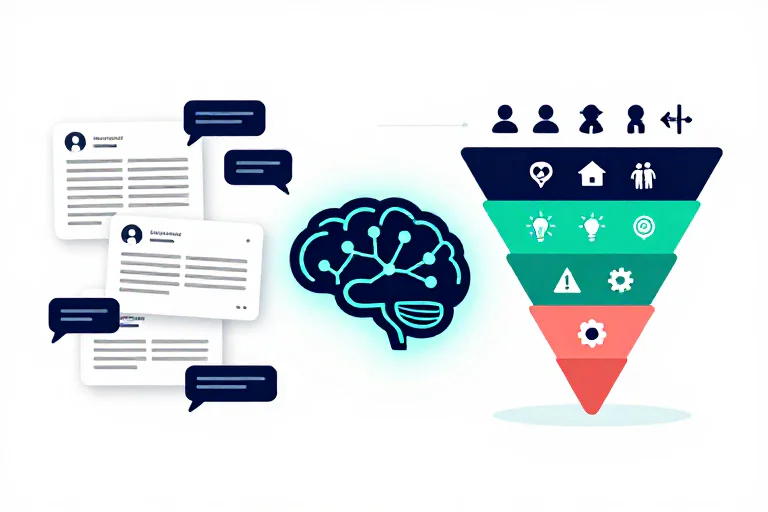
AI Customer Feedback Analysis: What to Extract and Why It Matters
Customer feedback contains far more information than positive and negative sentiment.
A customer might write:
“Looks beautiful, but it's smaller than I expected. I use it with my kids, so I wish it were larger.”
A basic AI analysis might classify this as:
Negative feedback — size
That is technically correct.
But it leaves most of the useful information untouched.
The customer also told you:
- What they like
- What they expected
- How they use the product
- Who uses it with them
- What doesn't fit their situation
- What they would prefer instead
The valuable information is not just the sentiment.
It is the context behind the sentiment.
This is why AI customer feedback analysis should move beyond:
Positive vs. negative
and toward a deeper chain:
Feedback
↓
Sentiment
↓
Theme
↓
Context
↓
Need
↓
Friction
↓
Opportunity
The purpose is not to force every piece of feedback through every layer.
The purpose is to progressively ask better questions about what the customer is telling you.
Sentiment Is Useful—but It Is Not Customer Insight
Sentiment analysis is one of the easiest things for AI to perform.
Given:
“I absolutely love this product.”
AI can identify:
Positive.
Given:
“Very disappointed. It broke after two weeks.”
AI can identify:
Negative.
This is useful.
If you have 100,000 pieces of feedback, knowing the overall sentiment distribution can help you understand the broad state of customer perception.
For example:
Positive: 72%
Neutral: 14%
Negative: 14%
But what does this actually tell you?
Not much about why.
Two products could both have:
72% positive sentiment.
Yet their customer experiences could be completely different.
Product A:
Customers love the design but complain about durability.
Product B:
Customers love the durability but find the design outdated.
The average sentiment is identical.
The business implications are not.
This is why:
Sentiment is a measurement of customer expression, not a complete explanation of customer experience.
Layer 1: Sentiment
Sentiment should therefore be treated as a starting signal.
You can identify:
- Positive reactions
- Negative reactions
- Mixed reactions
- Strong emotional reactions
- Weak emotional reactions
But don't immediately convert sentiment into a business conclusion.
For example:
“I like it, but it takes too long to clean.”
is not simply positive or negative.
It contains both:
Positive
→ Product experience

Negative
→ Usage friction
This is one reason why simple sentiment percentages can hide useful information.
A customer can be satisfied with a product overall while still revealing an important unmet need.
Layer 2: Theme
After understanding sentiment, the next question is:
What are customers talking about?
AI can cluster feedback into themes such as:
- Design
- Size
- Price
- Durability
- Cleaning
- Setup
- Comfort
- Performance
- Shipping
- Customer support
This is more informative than sentiment alone.
Instead of:
18% negative
you might discover:
42% of negative feedback relates to cleaning.
Now you know where to investigate.
But there is still a problem.
A theme is not necessarily a customer problem.
Theme Is Not the Same as Need
Suppose AI identifies:
Size
as one of the most common themes.
That does not mean:
Customers need a larger product.
You still need context.
Consider:
“Too small for my family.”
and:
“Small enough to fit perfectly in my apartment.”
Both mention size.
One is negative.
The other is positive.
The theme is the same.
The customer need is different.
This is why a good feedback analysis cannot stop at theme extraction.
You have to understand:
Why does this theme matter to this customer?
Layer 3: Context
Context is where customer feedback starts becoming much more useful.
Context describes the situation surrounding the customer's experience.
Depending on the product, this can include:
- Who is using the product
- How many people use it
- Where it is used
- When it is used
- How frequently it is used
- What the customer is trying to accomplish
- What constraints exist
- What other products or alternatives are involved
Consider these two customers:
Customer A
“It's small, but perfect for my apartment.”
Customer B
“It's too small for my family.”
Both are talking about size.
But their scenarios are fundamentally different.
The first customer values:
Space efficiency.
The second values:
Shared capacity.
Without context, an AI system might simply conclude:
“Size is frequently mentioned.”
With context, you can begin to understand:
Different customer scenarios create different meanings for the same product attribute.
Why Context Is Often More Valuable Than the Keyword
Consider the statement:
“Beautiful.”
On its own, this is weak information.
But imagine the customer says:
“Beautiful. It finally makes my small bedroom feel put together without making it look crowded.”
Now you have much more.
The customer isn't simply saying:
“I like the appearance.”
They are describing a relationship between:
Small bedroom
+
Aesthetic preference
+
Space constraint
+
Desired environment
That context is much more valuable than the word:
“Beautiful.”
This is why AI analysis should preserve the surrounding customer language instead of reducing feedback to isolated keywords.
Layer 4: Need
Once you understand the context, you can begin asking:
What does this customer actually need?
This is where analysis becomes more difficult.
A customer may say:
“I wish it were bigger.”
The obvious interpretation is:
Need a larger product.
But perhaps the actual scenario is:
A family wants to use it together.
The underlying need may therefore be:
More capacity for shared use.
That distinction matters.
A larger product is one possible solution.
It is not necessarily the need itself.
This difference becomes particularly important when researching new products.
If you confuse:
Customer-requested solution
with:
Underlying customer need,
you can easily build the wrong thing.
Layer 5: Friction
Another useful layer is friction.
Friction describes what makes the customer's experience harder than it should be.
Examples include:
- Difficult setup
- Difficult cleaning
- Unclear information
- Poor fit
- Lack of capacity
- Lack of compatibility
- Uncertainty before purchase
- High perceived risk
- High effort during use
For example:
“I love the product, but cleaning it every day is annoying.”
The sentiment is positive.
The theme might be:
Cleaning.
The context might be:
Daily use.
The friction is:
High maintenance effort.
This is an important distinction.
A product can have high customer satisfaction while still containing significant friction.
That friction may represent a future product opportunity.
Layer 6: Opportunity
Only after understanding the customer should you start thinking about opportunities.
Suppose your analysis discovers:
Customer scenario:
Families

Repeated friction:
Insufficient capacity

Desired outcome:
Shared use

Existing solution:
Current product size

Gap:
Current configuration does not fit shared use
You might now have an opportunity hypothesis:
A larger version could better serve family users.
But this is still a hypothesis.
You have not yet established that it is a good business opportunity.
You still need to ask:
- How many customers have this need?
- How strong is the need?
- Are they willing to pay?
- Are competitors already solving it?
- Is the market large enough?
- What would the product cost?
- Would the margin work?
- Is the need frequent enough?
- Are customers actively looking for a solution?
Customer feedback can reveal the opportunity.
It cannot, by itself, prove the opportunity is commercially viable.
The Full Analysis Chain
This gives us a more complete way to think about customer feedback:
Raw Feedback
      ↓
Sentiment
      ↓
Theme
      ↓
Context
      ↓
Need
      ↓
Friction
      ↓
Opportunity
Each layer answers a different question.
| Layer | Question |
|---|---|
| Sentiment | How does the customer feel? |
| Theme | What are they talking about? |
| Context | What situation are they in? |
| Need | What are they trying to achieve? |
| Friction | What makes that difficult? |
| Opportunity | What could potentially be improved or created? |
The important point is that these layers should not be confused.
For example:
“31% mention color.”
is a theme-level finding.
It is not yet:
“31% of customers need more color options.”
You need to understand the customer context first.
AI Makes This Analysis More Practical
Historically, this kind of analysis was difficult to perform at scale.
A human analyst could manually read a few hundred reviews and identify patterns.
But analyzing:
- 3,000 reviews
- 30,000 reviews
- 300,000 comments
- Customer support conversations
- Survey responses
- Product questions
is much harder.
AI changes the economics of this process.
It can repeatedly perform tasks such as:
- Classification
- Clustering
- Scenario extraction
- Pattern detection
- Comparison
- Subgroup analysis
- Cross-review analysis
- Hypothesis generation
This doesn't mean AI replaces analytical thinking.
It means:
The analytical framework can be applied to much more customer data than a human could reasonably process manually.
But AI Needs an Analytical Context
There is a common assumption that AI can simply receive raw customer feedback and figure everything out.
In practice, the quality of the analysis depends heavily on the context you provide.
For example, suppose you want AI to classify customer scenarios.
You need to define:
What counts as a scenario?
You might tell AI that a scenario should consider:
- Number of users
- Location
- Time
- Usage purpose
- Customer constraints
Now AI has a framework for interpreting the data.
Without that context, AI may create categories that look reasonable but do not match how you actually want to understand the market.
This leads to an important principle:
AI is much more useful when it operates inside a well-designed analytical framework.
The framework contains the analyst's:
- Experience
- Assumptions
- Models
- Definitions
- Judgment criteria
- Validation requirements
AI then becomes a powerful executor of that framework.
Don't Let AI Invent Customer Needs
There is another important distinction.
If you ask:
“Analyze these reviews and tell me what customers need.”
AI can generate a convincing answer.
But a convincing answer is not necessarily a reliable one.
A better approach is to constrain the analysis.
For example:
First identify customer scenarios.
Then:
Within each scenario, identify recurring customer problems.
Then:
Identify the desired outcome behind those problems.
Then:
Look for evidence across multiple reviews.
Then:
Identify potential unmet needs.
Then:
Mark uncertain conclusions as hypotheses.
This creates a chain of reasoning.
Instead of asking AI to:
Invent the answer
you ask it to:
Investigate the evidence.
Why Multi-Round Analysis Matters
Deep customer insight rarely comes from one prompt.
Consider a dataset of 3,000 reviews.
Your first analysis might discover:
Size is frequently discussed.
You then ask:
Which customer groups mention size?
The answer might be:
Families and small-apartment users.
Then ask:
Why do these groups mention size?
You might discover:
Families want more capacity.
Small-apartment users want better space efficiency.
Now the original “size” theme has split into two different needs.
Then you can investigate each one separately.
This is why:
Customer understanding is often an iterative process rather than a single AI generation.
Statistics Still Matter
Moving beyond statistics does not mean statistics are useless.
They provide important signals.
For example:
23% of customers mention a particular need.
That tells you the signal is widespread enough to investigate.
But the percentage does not tell you:
- Why they have the need
- How important it is
- Whether they will pay for a solution
- Whether it affects actual usage
- Whether competitors already solve it
- Whether the segment is commercially valuable
Statistics describe the observed data.
Deeper analysis helps explain the data.
Both are necessary.
Don't Confuse Frequency With Importance
Imagine two customer groups.
Group A
30% of customers mention a minor inconvenience.
Group B
3% of customers have a severe problem and are actively looking for a solution.
Which opportunity is more valuable?
You cannot answer that from frequency alone.
The smaller group might:
- Have stronger pain
- Be more willing to pay
- Have higher purchase intent
- Generate higher margins
- Represent an attractive market segment
This is why:
Frequency is a signal of scale, not a universal measure of value.
Business analysis needs additional context.
Customer Feedback Is Only One Source of Truth
Another important limitation:
Customer feedback does not represent the entire customer base.
Some customers leave detailed reviews.
Some leave one sentence.
Some never leave a review.
Some experience problems but don't complain publicly.
Some customers return products without explaining why.
Some customers quietly switch to competitors.
Therefore, an important insight should ideally be compared with other sources.
Depending on the business, these could include:
- Return rates
- Customer support
- Product questions
- Sales data
- Usage data
- Repeat purchase behavior
- Search behavior
- Competitor feedback
- Market research
This is especially important when making significant product decisions.
From Feedback to Decision
The complete process can therefore look like this:
Customer Feedback
       ↓
Overall Analysis
       ↓
Sentiment
       ↓
Themes
       ↓
Customer Scenarios
       ↓
Needs
       ↓
Friction
       ↓
Potential Opportunities
       ↓
Market Validation
       ↓
Competitor Analysis
       ↓
Commercial Evaluation
       ↓
Human Decision
Notice what happens at the end.
The process does not say:
AI decides what the company should do.
It says:
AI helps the business understand the customer deeply enough to make a better decision.
That distinction is fundamental.
A Practical AI Customer Feedback Workflow
If you want to start analyzing customer feedback today, a simple workflow is:
1. Collect
Gather:
- Reviews
- Feedback
- Comments
- Support conversations
- Surveys
- Product questions
2. Analyze
Ask AI to identify:
- Major themes
- Sentiment
- Initial clusters
- Potential customer scenarios
3. Segment
Group feedback by:
- Customer type
- Usage scenario
- Relevant product context
4. Investigate
Within each important group, analyze:
- Needs
- Pain points
- Friction
- Motivations
- Objections
- Desired outcomes
5. Connect
Look for relationships between:
Scenario → Need
Need → Friction
Friction → Customer response
6. Generate hypotheses
Identify:
- Potential unmet needs
- Product opportunities
- Positioning opportunities
- Experience improvements
7. Validate
Compare important findings against:
- Market
- Competition
- Behavioral data
- Commercial data
8. Decide
Use the findings as decision support.
Not as an automatic decision.
The Real Value of AI Customer Feedback Analysis
The biggest change AI brings to customer analysis is not simply that it can read more reviews.
It is that it makes a deeper style of analysis more scalable.
Previously, a company might have relied heavily on:
Aggregate statistics
and then asked an experienced analyst to interpret them.
That process still has value.
But AI makes it more practical to repeatedly investigate customer groups, scenarios, language, patterns, and possible motivations across much larger datasets.
That creates an opportunity to move from:
“How many customers said this?”
toward:
“Who said this, in what situation, why might it matter, and what should we investigate next?”
That is a fundamentally richer way to understand customers.
Final Framework
Customer feedback should not be treated as a collection of opinions to summarize.
It can be treated as raw evidence.
A useful analysis progressively transforms that evidence:
Feedback
   ↓
Sentiment
   ↓
Theme
   ↓
Context
   ↓
Need
   ↓
Friction
   ↓
Opportunity
But the process does not end at opportunity.
The opportunity still needs to be tested against:
Market + Competition + Cost + Demand + Willingness to Pay + Business Constraints
And AI should not replace that judgment.
Its greatest value is helping you perform deeper analysis at a scale that would otherwise be difficult to achieve manually.
The goal is therefore not:
Use AI to summarize customer feedback.
It is:
Use AI to investigate customer feedback more deeply, systematically, and at scale.
Because the difference between a useful customer analysis and a shallow one is rarely the amount of data.
It is the quality of the questions asked of that data.
Related Articles
What Is Customer Intelligence?
Understand the broader approach to turning customer signals into deeper business insight.
How to Analyze Customer Reviews With AI
Learn how to move from raw reviews to customer scenarios, needs, motivations, and opportunities.
What Do Negative Reviews Really Tell You About Your Customers?
Understand why a negative review is a signal to investigate rather than an automatic diagnosis of a product problem.
Why Do Customers Say “Too Expensive” When Price Isn't the Real Problem?
Explore why price complaints can actually reveal problems with perceived value, trust, differentiation, urgency, or expectations.
AI Customer & Review Insight Analyzer
Turn reviews, feedback, and comments into structured customer signals for further analysis.